

Think you’re wasting money insuring a clunker?
Maybe you are.
If the yearly cost of collision plus comprehensive is more than about 10 percent of what your car is worth, it often makes sense to drop them.
This quick rule, plus checking your deductible and whether you still owe money, is the simplest way to decide.
Read on for a clear, step-by-step test you can run in five minutes to see if keeping those coverages still helps you, or if you’re better off banking the premiums toward your next car.
Key Factors That Determine When to Drop Collision and Comprehensive Coverage

The most reliable starting point? The 10 percent rule. If the combined annual cost of collision and comprehensive insurance exceeds 10 percent of your car’s current actual cash value, those coverages usually aren’t cost-effective anymore. This threshold makes sense because any claim payout can never exceed the vehicle’s ACV, no matter how much you’re paying in premiums.
Vehicle depreciation is the other big factor. Older cars lose value quickly, and that falling ACV shrinks the maximum check you can receive after a total loss. Once your car’s worth just a few thousand dollars, even a modest annual premium can exceed the realistic benefit.
Here’s what to weigh before deciding:
Current market value (ACV): Get a recent estimate from Kelley Blue Book, Edmunds, or your insurer’s valuation tool.
Annual premium for collision plus comprehensive: Add up what you pay each year for both coverages combined.
Deductible amount: Typical deductibles range from $500 to $1,000. This is the amount subtracted from any payout.
Loan or lease status: If you still owe money or lease the vehicle, lenders require full coverage until the contract ends.
Quick formula test: If (Annual Premium + Deductible) is close to or greater than your car’s value, drop the coverage.
Low-value cars rarely justify the cost. When a vehicle’s worth $2,000 and you’re paying $400 per year in premiums with a $1,000 deductible, the maximum net benefit from a total-loss claim is only $1,000 (car value minus deductible). After just 2.5 years of premiums, you’ve paid more than you could ever recover. That math makes dropping collision and comprehensive a smart financial choice for most owners of older, fully paid vehicles.
Cost-Benefit Analysis of Keeping or Dropping Coverage

Collision coverage typically costs more than comprehensive, but both decline in value as your car ages. Average premiums for collision might run $250 to $500 per year. Comprehensive often sits between $100 and $200. Deductibles usually range from $500 to $1,000. When you combine those two numbers, the real payout shrinks fast.
Here’s a simple example. Say your car’s worth $3,000, your combined annual premium is $450, and your deductible is $1,000. If you total the car, the insurer pays $3,000 minus the $1,000 deductible, leaving you $2,000. After paying $450 in premiums, your net benefit for that year is $1,550. If you don’t file a claim, you’ve spent $450 for zero return. Over three claim-free years, you’ve paid $1,350 in premiums for coverage on a car that’s only worth $3,000 (and dropping every month).
The math gets worse as ACV falls. Once a car hits $1,500 in value, a $500 annual premium represents 33 percent of the vehicle’s worth. Even if you avoid a deductible increase, the maximum possible net payout (value minus deductible) might be only $500 to $1,000. You’re paying a large share of the car’s replacement cost each year just to insure it. That’s the textbook definition of diminishing returns.
Vehicle Value Milestones That Signal It May Be Time to Drop Coverage

Cars lose about 60 percent of their value in the first five years. Depreciation continues steadily after that. By the time a vehicle reaches ten years old, its actual cash value often sits well below $5,000. Insurance payouts are capped at ACV, so once your car’s worth $2,000, that’s the absolute ceiling for any claim, before you subtract the deductible.
Specific dollar milestones make the decision clearer. Use these benchmarks as starting points:
$4,000 or less: Strongly consider dropping collision. Keep comprehensive only if you live in a high-theft or severe-weather area.
$3,000 or less: Drop collision in nearly all cases. Evaluate comprehensive based on local risk (hail, flooding, theft).
$2,000 or less: Drop both collision and comprehensive unless you have zero emergency savings and can’t afford any out-of-pocket repair or replacement cost.
$1,000 or less: Almost always drop both coverages. Premiums and deductibles will approach or exceed the vehicle’s entire value.
When your car’s value dips into the $1,000 to $2,000 range, paying any premium over $200 per year for collision and comprehensive becomes hard to justify on pure math. At that point, you’re better off setting aside the premium dollars in a dedicated car-replacement fund.
Real-World Scenarios Using Common Car Ages and Values
A 10-year-old sedan in average condition might be worth around $3,500. If your combined collision and comprehensive premium is $400 per year with a $1,000 deductible, the 10 percent threshold is $350. You’re slightly over that line, so it’s time to consider dropping collision at minimum. If you live in an area with low theft and minimal weather risk, dropping both makes sense. If hail or flooding’s common, keep comprehensive ($100 to $150 per year) and drop collision.
A 12-year-old compact car with higher mileage often sits around $2,000 in value. Annual premiums for collision and comprehensive might total $350, and your deductible is $500. The 10 percent rule says anything over $200 is questionable. In this case, you’re paying 17.5 percent of the car’s value every year. Even one year of premiums eats nearly a fifth of what the car’s worth. Drop both coverages and bank that $350 toward your next vehicle or emergency repairs.
A 15-year-old economy car in fair shape might only be worth $1,000. If you’re still carrying collision and comprehensive at a combined $250 per year with a $1,000 deductible, the coverage is pointless. The maximum net payout after deductible is zero dollars (car value equals deductible). You’re paying $250 annually to insure something the policy can’t actually replace. Drop both immediately.
High-mileage trucks and SUVs can hold value better than sedans, even at 10 to 12 years old. A work truck worth $6,000 with $500 in annual premiums and a $1,000 deductible still passes the 10 percent test ($600 threshold). In this case, keeping collision makes sense if you depend on the vehicle for income or daily work. You might raise the deductible to $1,500 to lower the premium and reassess next year as the truck continues to depreciate.
When You Cannot Drop Collision or Comprehensive

If you’re still making payments on an auto loan or driving a leased vehicle, your contract almost certainly requires collision and comprehensive coverage until the loan’s paid off or the lease ends. Lenders hold a financial interest in the car, and they protect that interest by mandating full coverage. If you drop the coverage without paying off the loan, the lender will force-place insurance at a much higher cost and possibly penalize you for breach of contract.
The same rule applies even if your car’s value has dropped below the amount you owe. Let’s say you owe $5,000 on a car now worth $3,000. You’re upside down, but the lender still requires collision and comprehensive. If you total the car, the insurer pays the $3,000 ACV, and you’re still responsible for the remaining $2,000 loan balance (unless you carry gap insurance). You can’t legally drop the coverage until the loan balance is zero and the lender releases the title, regardless of how low the car’s value falls.
Step-by-Step Decision Rubric to Determine Whether to Drop Coverage
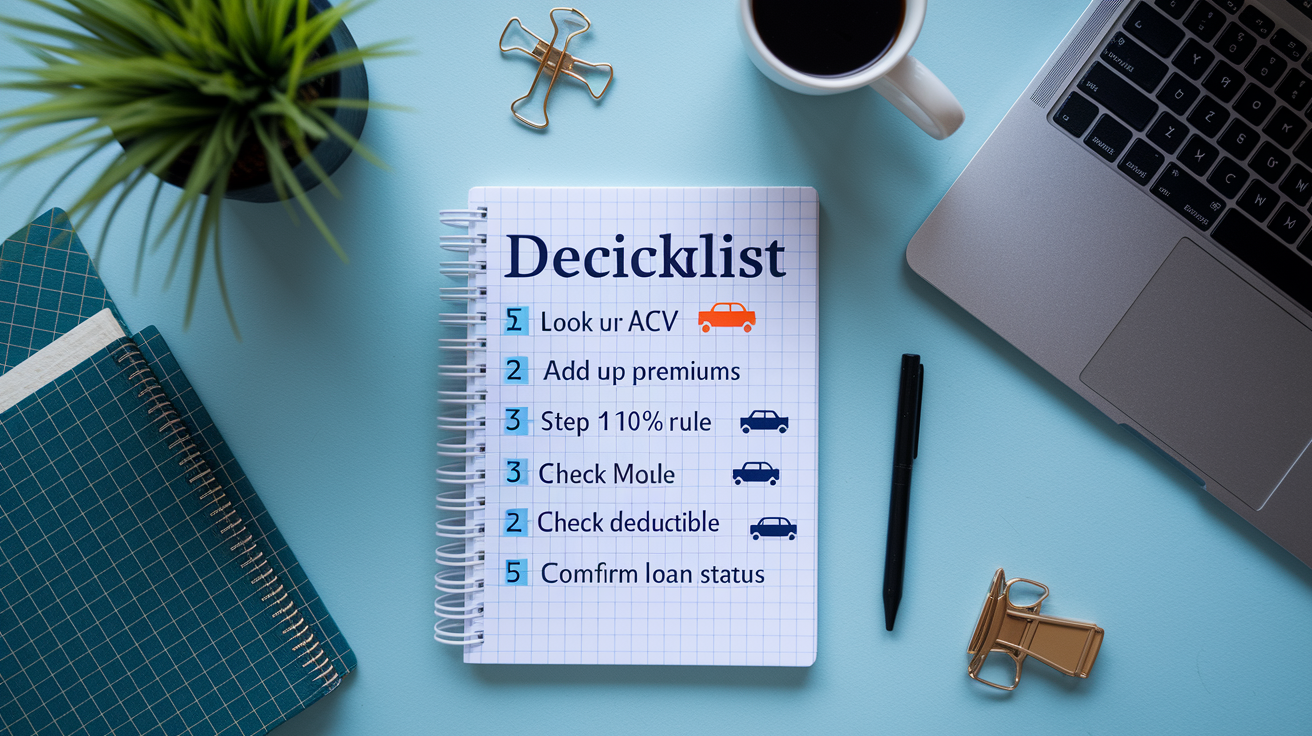
Use this simple five-step process every year when your policy renews:
- Look up your car’s current actual cash value using Kelley Blue Book, Edmunds, or your insurer’s online tool.
- Add up your annual collision premium and annual comprehensive premium to get your total yearly cost for these two coverages.
- Apply the 10 percent rule. Multiply your car’s ACV by 0.10. If your annual premium exceeds that number, dropping coverage is usually the right move.
- Check your deductible. If your car’s value is less than or equal to your deductible, the coverage is worthless (you’d get zero dollars after a total loss).
- Confirm loan or lease status. If you owe money or lease the vehicle, you must keep collision and comprehensive regardless of value.
| Factor | What to Check | Why It Matters |
|---|---|---|
| Actual Cash Value (ACV) | Current market price from KBB, Edmunds, or insurer estimate | ACV is the maximum payout; if ACV is low, coverage value is low |
| Annual Premiums | Total yearly cost for collision + comprehensive combined | Compare to 10% of ACV; high premiums relative to value signal time to drop |
| Deductible | Amount you pay before insurance pays (typically $500–$1,000) | Deductible reduces net payout; if deductible ≥ ACV, drop coverage immediately |
| Lender Status | Do you owe money on a loan or lease? | Lenders require full coverage until loan is paid off; you cannot drop if financed |
Final Words
in the action, we ran the numbers: the 10 percent rule, the Premium + Deductible > Car Value check, clear value milestones ($4,000–$1,000), real examples by car age, cost vs payout math, lender limits, and a short decision rubric.
Use the checklist: plug in your car’s ACV, annual premiums, and deductible, then see if the expected payout makes sense. If you still owe the lender, don’t drop coverage yet.
If you’re deciding when to drop collision and comprehensive on an older car, run the simple math and follow the steps here. You’ll keep needed protection without wasting money.
FAQ
Q: Is it worth having comprehensive and collision insurance on an old car?
A: Having comprehensive and collision on an old car is often not cost-effective if annual premiums plus the deductible approach or exceed the car’s value; check your car’s ACV and compare costs before keeping them.
Q: When should you drop collision insurance on an older car? At what point should I remove full coverage insurance?
A: You should drop collision or full coverage on an older car when the annual premium plus deductible is greater than the car’s market value, unless a lender or lease contract still requires you to keep it.
Q: What is the 10 rule for collision insurance?
A: The 10 percent rule for collision insurance says if the yearly cost for collision and comprehensive is more than 10% of your car’s value, keeping those coverages is usually not worth the price.