

Think calling your insurer first after a crash is the smartest move?
Not always. If you don’t collect the right details at the scene, your claim can stall for weeks while you hunt down a police report or the other driver’s policy number.
This post shows the 6 things to have ready before you file: policy and contact info, time and place, driver and vehicle details, photos and video, police report data, and witness contacts.
Do this once at the scene and you’ll speed up the claim.
Core Information Required Before Filing a Car Insurance Claim
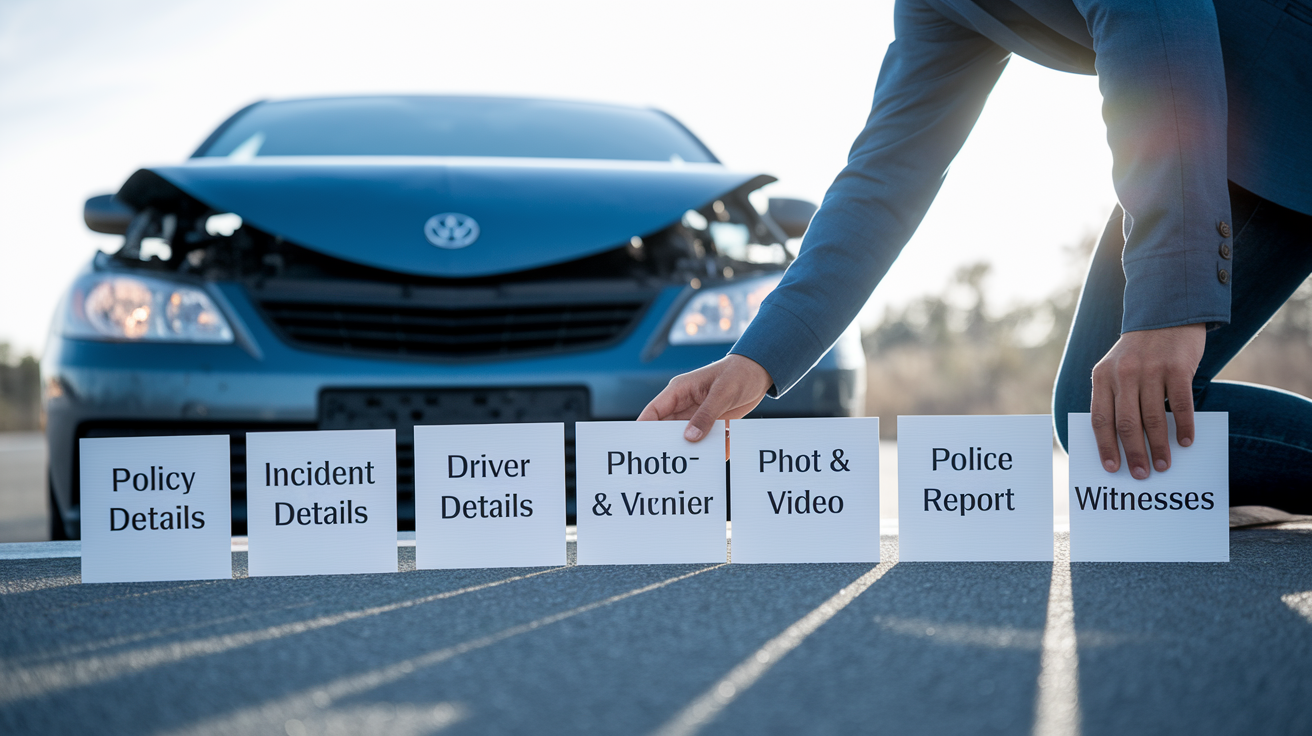
You’ll save yourself weeks of back-and-forth if you gather everything at the scene. When you hand your insurer a complete package, they process your claim faster. Miss a police report number or forget to grab the other driver’s insurance info? Your adjuster stops your file until you track it down.
You need six categories ready before you file:
- Your policy details and how you want to be contacted
- When and where it happened
- Driver and vehicle info for everyone involved
- Photos and video
- Police report details and officer contact info
- Witness names and numbers
The more complete your list, the fewer delays you’ll hit.
Organizing Driver, Vehicle, and Policy Details for Your Insurance Claim
Start with your policy number. That’s the 9 to 12 digit code on your insurance ID card, usually at the top. You’ll also need your insurance company’s name and the exact vehicle that was in the crash. If you insure three cars and only one got hit, tell your adjuster which one by year, make, and model. They can’t open a file without knowing which vehicle and which driver were involved.
Next, collect the same info for every other driver. Full name, phone number, address. Driver’s license number and the state that issued it. Their insurance company and policy number if they’ve got a card on them. Then move to the vehicle. License plate number and state, VIN, year, make, model.
Here’s where to find the key pieces:
- VIN: look through the windshield on the driver’s side at the base of the glass, or check the door jamb sticker.
- License plate: front or rear bumper. Write down the full plate and state.
- Your policy number: printed on your ID card, declarations page, or in your insurer’s app.
- Other driver’s policy number: ask to photograph their insurance card at the scene.
- Driver’s license number: ask to see and photograph their license. Note the state.
Can’t get one piece at the scene? Write down what you have and tell your insurer about the gap right away.
Police Report and Law Enforcement Details Needed for a Claim
Your insurer’s going to ask whether police showed up and whether a report was filed. If you called 911 or the non-emergency line and an officer arrived, you need the law enforcement agency name, the officer’s name and badge number, and the police report number. Report numbers usually show up within 24 to 48 hours. If the officer didn’t hand you a number at the scene, ask how to get it and write down the agency phone number or website.
If you or the other driver got a ticket, keep a copy. The citation number and violation code help adjusters figure out fault. If police didn’t come, note that in your written description and explain why. In a lot of states, officers won’t respond to minor property damage on private property, but your insurer still needs to know the crash happened.
Hit and run claims need extra documentation. If the other driver took off, write down the exact time, the direction they went, any visible plate characters even if partial, vehicle color and type, anything else you saw. File a police report immediately, even if the officer can’t find the other driver. Your uninsured motorist or collision coverage may kick in, but you need an official report number to back up that claim.
Record these items at the scene or within the first day:
- Law enforcement agency name and jurisdiction
- Officer name and badge number
- Police report or incident number
- How to retrieve the report online or by phone
- Any ticket or citation numbers issued to any driver
- Date and time the report was filed
Hit and run? Add the direction the vehicle traveled and any witness who saw them leave.
Photos, Videos, and Evidence Needed for a Strong Car Insurance Claim

Your phone’s the fastest claims tool you’ve got. Take at least 8 to 12 photos at the scene before vehicles get moved. Start with wide shots that show the whole scene from two or more angles. Capture road signs, traffic lights, lane markings, skid marks, debris, anything that shows how the crash went down. Then zoom in. Photograph every dent, scratch, broken light, deployed airbag, fluid leak on your vehicle. Same for the other vehicles.
Next, get the license plates, the VIN visible through the windshield, and your odometer reading. If you’ve got visible injuries, bruises, cuts, torn clothing, photograph those. Personal property damaged? Cracked phone, broken glasses, spilled groceries? Photo of each item. Weather and lighting matter, so if it’s raining, dark, or foggy, include a shot that shows the conditions.
Required Photo Angles and Quantities
You need four corner shots of each vehicle. Stand at the front left, front right, rear left, and rear right corners of your car and take one photo from each spot. Gives the adjuster a complete view of all damage. Do the same for the other vehicles if you can safely get close. Add close-ups of specific damage areas, at least two or three shots per damaged panel or part.
Take one short video, 20 to 60 seconds, walking slowly around the scene. Narrate what you’re recording if it helps, but keep it factual. Video captures details a still photo might miss. The position of the vehicles relative to the road, the working condition of traffic signals, parking lot layout.
Keep the damaged vehicle in the same condition until the adjuster or repair shop inspects it. Don’t wash it, don’t fix dents, don’t start repairs unless you need emergency work to make the car safe or drivable. If you have to move the vehicle for safety, photograph its original position first, then photograph where you moved it and explain why in your notes.
Receipts, Estimates, and Financial Documents Required for Filing a Claim
(((alt-img5)))
Insurers reimburse covered losses only when you prove the expense. Save every receipt related to the crash. Car got towed? Keep the towing invoice with the date, company name, dollar amount. Paid for emergency repairs, glass replacement, or a locksmith? Keep itemized invoices.
Get at least two repair estimates. Three’s better. A lot of insurers send you to a preferred shop, but you can get independent estimates too. Each estimate should include the shop name, contact info, estimate date, and a line-by-line breakdown of parts and labor. If the estimates differ by hundreds of dollars, document the differences and ask the adjuster which one they’ll use or whether they’ll send their own appraiser.
Rented a car while yours was being repaired? Keep the rental agreement and all daily invoices. Daily rate, total days, mileage charges, any add-ons like insurance waivers. Your rental reimbursement coverage has daily and total limits, so compare your receipts against your policy limits before you return the car.
| Document Type | Required Details | Example |
|---|---|---|
| Towing invoice | Company name, date, amount paid, destination | City Tow: $245.00 on 04/13/2026 to ABC Auto Body |
| Repair estimate | Shop name, date, itemized parts/labor, total cost | ABC Auto Body: $3,120 estimate dated 04/14/2026 |
| Rental car receipt | Daily rate, number of days, total charges, company | Rental Co.: $42/day for 10 days = $420 total |
| Emergency repair receipt | Service performed, parts replaced, date, invoice number | Glass shop: windshield replacement $310 on 04/13/2026 |
| Medical bills | Provider name, date of service, diagnosis code, itemized charges | City ER: $1,200 on 04/13/2026; CPT 99283, laceration repair |
| Lost wages proof | Pay stubs, employer letter, dates missed, hourly rate or salary | Employer letter: missed 04/14–04/18, $18/hour, 32 hours = $576 |
Scan or photograph every receipt the same day you get it. Save digital copies in a folder labeled with the crash date, like AutoClaim_20260413. Keep the paper originals in one envelope. If a receipt fades or gets lost, you’ve got the backup file ready to send.
Medical and Injury Information Needed for an Insurance Claim
(((alt-img6)))
If anyone was injured, even if it seemed minor at the scene, document every medical visit from day one. Write down the date and time you went to the ER, urgent care, or your doctor’s office. Record the hospital or clinic name, the treating physician or nurse, the reason for the visit. Keep itemized bills that show the date of service, procedures or tests performed, diagnosis or treatment codes.
Prescription receipts matter. If the doctor prescribed pain meds, antibiotics, or physical therapy, keep the pharmacy receipts and any follow-up prescriptions. Attend PT, occupational therapy, or chiropractic visits? Save the appointment summaries and invoices. The insurer’s going to ask how many sessions you completed, cost per session, whether the provider recommended continuing treatment.
Take clear photos of visible injuries on the day of the crash and again a few days later when bruising fully appears. Cuts, scrapes, swelling, casts, bandages, stitches. If clothing was torn or bloodied, photograph that. The timeline of your injuries starts with your first medical visit. Waiting several days to see a doctor creates questions about whether the injury came from the crash, so get treatment the same day or the next day if you’re hurt.
How to Prepare Your Written Accident Description and Witness Statements
(((alt-img7)))
Your adjuster’s going to ask you to describe what happened in your own words. Write a short, neutral, time-ordered description. Two to five sentences. Start with where you were going and what you were doing just before the crash. Explain what you saw, what the other driver did, what happened at impact. Don’t guess about the other driver’s intent or admit fault. Just state the facts.
Witness statements add independent support to your version. If someone stopped to help or saw the crash happen, ask for their name and phone number. A witness statement can be as short as one to three sentences. Where they were standing or driving, what they saw, when they saw it. If the witness is willing, record a quick video statement on your phone or ask them to write a few sentences and sign their name.
Your written description should include:
- What you were doing immediately before the crash. I was stopped at the red light on Main and Fifth.
- What the other driver or vehicle did. The blue sedan ran the red light and struck my front passenger door.
- The moment of impact and immediate result. I heard the crash and felt the airbag deploy.
- Weather, road, and visibility conditions if relevant. It was raining and the road was wet.
Keep your language simple and factual. Not sure about a detail? Say so instead of guessing.
Claim Filing Steps and What Your Insurer Will Ask For
(((alt-img8)))
Most insurers expect you to report a claim within 24 to 72 hours after the crash. Check your policy for the exact deadline. When you’re ready to file, call the claims number on your insurance card or log in to your insurer’s app or website. Have your policy number, the date and time of the crash, the exact location, and a short description ready before you start the call.
The claims rep opens your file, assigns a claim number, and connects you to an adjuster within one to three business days. Write down the claim number, the adjuster’s name, phone number, email. Ask when the adjuster will contact you and what documents to send first. A lot of adjusters request photos, the police report number, repair estimates, and receipts right away.
Information You Must Have Ready When You Call
When you contact your insurer, gather these items in one place:
- Your insurance policy number and the specific vehicle involved
- Date, time, exact location of the crash or incident
- Names, phone numbers, insurance details for all other drivers
- Police report number or the name and badge number of the responding officer
- A list of the photos you took and the file names or count
- Towing receipts, rental agreements, emergency repair invoices
- Names and contact info for any witnesses
- Your preferred contact method and the best times to reach you
After you file, the adjuster typically asks for these next steps:
- Schedule a vehicle inspection at a certified repair shop or an independent appraiser.
- Submit all photos, videos, police report, and repair estimates by email or through the claims portal.
- Provide medical records, bills, lost wage documentation if injuries are part of the claim.
- Confirm your deductible amount and coverage limits so the adjuster can calculate the payout.
Keep a simple log of every conversation. Write down the date, time, the person’s name, one sentence summary of what was discussed. You’ll refer back to this log if questions come up or timelines start to slip.
Optional but Helpful Evidence That Strengthens Your Car Insurance Claim
(((alt-img9)))
If you’ve got photos of your vehicle from before the crash, send those to the adjuster. Pre-accident photos show the condition of your car and help prove that dents or scratches are new. Detailed your car a week before the crash and took pictures? Those images become useful evidence. Same goes for maintenance records. If your car was in good working order before the crash, receipts for recent oil changes, tire rotations, or inspections support your claim that the damage came from the accident and not from prior neglect.
Dashboard camera footage, home security video, or traffic camera recordings can give an independent view of what happened. If your dashcam captured the crash, save the file immediately and label it with the date and time. Some smartphones have crash detection features that log the exact moment of impact and your location. If your phone recorded that data, screenshot the details and include them with your claim file. If a nearby business or intersection has CCTV, ask whether they can save the footage and provide a contact name and number to your adjuster. Traffic camera footage’s often stored for only a few days, so request it quickly.
Final Words
You’re gathering photos, notes, and policy pages, and this guide walks you through the six big things insurers want: policy and driver details, police report info, photos and video, repair and medical receipts, a short written accident statement, and the claim steps.
If you’re asking what information do I need to file a car insurance claim, grab those items, call your insurer with them, and keep copies. That simple plan speeds the process and makes handling the claim easier.
FAQ
Q: What information is needed to make an insurance claim?
A: The information needed to make an insurance claim includes your policy details, date/time/location of the crash, other driver and witness contacts, police report info, photos/videos, and repair or medical receipts to avoid delays.
Q: Can you claim for whiplash?
A: You can claim for whiplash if a doctor diagnoses it and links it to the crash. Submit early medical records, treatment notes, photos of symptoms, and any lost-wage proof to support the claim.
Q: What not to say when filing an insurance claim?
A: When filing an insurance claim, avoid admitting fault, guessing speeds or events, downplaying injuries, or offering extra unasked details. Stick to simple facts and say “I don’t know” if unsure.
Q: What’s the biggest mistake people often make when dealing with an insurance claim?
A: The biggest mistake people often make when dealing with an insurance claim is not documenting evidence or delaying medical care, then accepting a quick low offer. Document everything and get early records before negotiating.