

Think adding your teen to your policy is always the cheapest choice?
Not necessarily.
If your teen lives at home and drives a car you own, adding them usually costs less because of family and multi-car discounts.
But if the teen owns the car, lives away, or has tickets, a separate policy can protect your rates and might be the smarter move.
This guide walks through the costs, who’s primary on a claim, and a simple if-then checklist so you can pick the option that keeps you covered without surprises.
Key Decision Guide for Adding a Teen Driver vs. Getting a Separate Policy

Adding a teen to your family auto policy usually costs less than buying them a separate policy, as long as the teen drives a car you own and lives in your household. Most families see lower total insurance costs by keeping everyone on one policy because insurers bundle discounts, multi-car pricing, and shared liability limits together. A separate policy becomes the better choice when the teen owns the vehicle outright (meaning their name alone is on the title), when they live outside your home, or when their driving record is rough enough that you want to protect your own premiums.
Most insurers charge between $1,500 and $3,500 per year to add a teen, depending on your state, insurer, and the vehicle. A standalone teen policy often runs $2,500 to $6,000 annually. If your family premium is $1,200 a year and jumps to $3,200 after adding a teen, that’s a $2,000 increase. A separate policy might quote at $3,800, making it pricier than adding the teen. But isolating the teen’s record from yours can save you money down the road if violations or accidents happen.
Primary coverage follows whoever owns the vehicle. If your teen drives your car, your policy is primary. If the teen owns the car, the teen’s policy (or whoever insures that vehicle) is primary. Insurers require all licensed household drivers to be listed on the policy. Even if your teen rarely drives, you still need to notify your insurer and add them once they have a learner’s permit or license.
When adding to the family policy makes the most sense:
- Teen is under 18, lives at home, and drives a car you own.
- Your policy includes multi-car, bundling, or good driver discounts the teen can’t qualify for alone.
- You want the teen covered under your higher liability limits without paying for a second policy.
When a separate policy is usually the better route:
- The teen owns the vehicle and the title is solely in their name.
- The teen lives away from home (college, apartment, work relocation).
- The teen has major violations or accidents and you want to shield your premium and driving record from future rate spikes.
Cost Breakdown for Teen Driver Insurance Options

Adding a teen commonly raises a family policy premium by 50 percent to 100 percent. If your household pays $1,200 a year for two cars and two adults, adding a 16 year old might push that to $2,700 or $3,200. A separate teen policy for the same driver often quotes between $2,500 and $6,000 annually. In that example, your total household cost would be $1,200 (parents) plus $3,800 (teen standalone) for $5,000 total, compared to $3,200 for everyone on one policy. The separate route costs more up front, but it isolates the teen’s risk.
After a teen racks up a ticket or an at fault accident, the family policy can jump by another $500 to $1,500 at renewal. You might lose your good driver discount. Separating policies keeps those surcharges on the teen’s record only. If the teen has multiple infractions or a DUI, a separate policy can prevent your insurer from nonrenewing the whole household or reclassifying you as high risk. Separate policies function as financial firewalls when teen driving goes wrong.
| Option | Typical Annual Cost | Key Cost Driver |
|---|---|---|
| Add to Family Policy | $1,500–$3,500 increase | Teen age, multi-car discount, shared limits |
| Separate Teen Policy | $2,500–$6,000 standalone | New policy, no family discounts, high-risk classification |
Pros and Cons of Adding a Teen to an Existing Policy

Family policies already carry multi-car discounts, bundling savings (home plus auto), and credit based pricing tied to the named insured. When you add a teen, those discounts still apply, lowering the incremental cost. Your higher liability limits (say, 250/500 instead of state minimums) automatically extend to the teen when they drive your vehicles, which protects your household if the teen causes a serious accident. Managing one policy means one renewal date, one bill, and one agent relationship.
Adding a teen does expose your entire policy to premium increases after the teen’s violations. If your teen gets a speeding ticket or causes an accident, your insurer will surcharge the policy and you may lose your own good driver discount. If the teen accumulates major infractions (running red lights, reckless driving, DUI), the carrier may nonrenew the entire family policy or reclassify everyone as high risk. Some insurers also require the teen to be added if they’re a licensed household member who occasionally drives your cars. You may not have a choice if the teen lives at home.
Pros:
- Lowest total household cost due to multi-car, bundling, and good driver discounts.
- Simplified billing and one policy to manage.
- Teen benefits from parents’ higher liability limits.
- Often required by the insurer if the teen lives at home and drives household vehicles.
Cons:
- Parents’ premiums rise significantly after a teen’s ticket or accident.
- Loss of parents’ good driver discount if teen causes claims.
- Risk of nonrenewal if teen becomes high risk (DUI, multiple at fault accidents).
- May not be allowed if the teen primarily drives their own titled vehicle.
Pros and Cons of a Separate Teen Insurance Policy
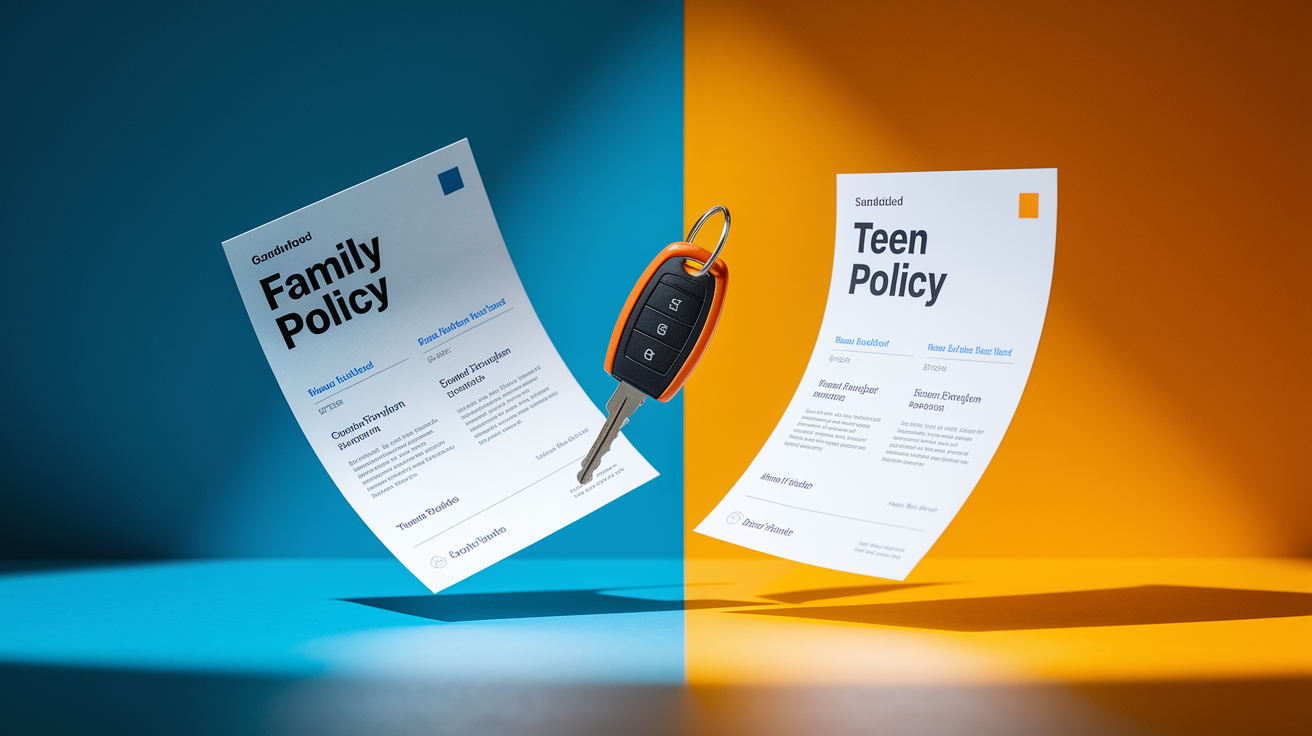
A separate policy is often required when the teen’s name is the sole name on the vehicle title. Most states follow the rule “you cannot insure what you do not own.” If your teen buys a car or you transfer the title entirely into their name, the teen must hold the policy for that vehicle. Separate coverage isolates the teen’s driving record from yours. When the teen gets a ticket or files a claim, the surcharge hits only the teen’s policy and your rates stay stable. You can also customize deductibles and drop collision or comprehensive if the teen drives an older beater with low market value, which can save money when full coverage isn’t worth the premium.
Standalone teen policies are typically the most expensive per driver option. Teens lack the discounts (multi-car, bundling, good credit) that adult household policies carry. Insurers price new teen policies at the top of the risk scale. Managing two policies means two renewal cycles, two bills, and two sets of paperwork. Some insurers won’t even offer a standalone policy to drivers under 18, so this route usually applies only when the teen is 18 or older and financially independent enough to own the car and pay the premium.
Pros:
- Required when the teen owns and titles the vehicle.
- Isolates the teen’s risk from parents’ driving records and premiums.
- Allows tailored deductibles and the option to drop collision/comprehensive on low value vehicles.
Cons:
- Usually the most expensive per driver option due to lack of family discounts.
- Managing multiple policies and payments.
- May not be available for drivers under 18 in some states or with some insurers.
How Policy Ownership, Title Status, and Residency Affect the Teen Driver Decision

The general rule is you cannot insure a vehicle you do not own. If the teen’s name is the only name on the title, most insurers require the teen to be the named insured on the policy for that car. Many agents don’t ask to see the vehicle title when you add a car to a policy, so ownership mismatches can go unnoticed until a claim. It’s your responsibility to verify that the policyholder matches the title holder. If you co-sign the title with your teen or the car remains titled in your name, you can usually keep the vehicle on your policy and list the teen as a driver.
Residency rules also shape the decision. Most insurers require all licensed household drivers to be listed on the policy, even if the teen rarely drives. If your teen moves out (college, apartment, job in another city), many carriers allow or require a separate policy tied to the teen’s new address. College students who live on campus but leave the car at home often stay on the family policy with an “away at school” discount. But if the teen takes the car to school, you may need to update the garaging address or move the teen to a separate policy depending on state rules and insurer guidelines.
Named driver endorsements and permissive use clauses determine who’s covered when someone else drives your car. If the teen is a listed driver on your policy, coverage applies when they drive any of your household vehicles. Permissive use typically extends your liability coverage to occasional drivers not listed on the policy. Repeated use by an unlisted teen can violate your policy terms. Insurers also enforce principal operator rules. If the teen is the primary driver of a specific vehicle, that vehicle often must be insured under the teen’s own policy, especially if the title is in the teen’s name. Check your state’s financial responsibility laws and your insurer’s underwriting guidelines to confirm requirements before deciding.
Coverage Differences Parents Should Know Before Choosing an Option

When you add a teen to your family policy, the teen drives under your liability limits. If you carry 250/500 bodily injury and 100 property damage, those limits apply when the teen causes an accident in your car. If you buy the teen a separate policy, you choose the liability limits for that policy. They can be lower (state minimums) or higher depending on budget and risk tolerance. Higher limits protect the teen and your household from catastrophic out of pocket exposure if the teen causes a serious multi-car crash.
Separate policies let you tailor collision and comprehensive deductibles to the teen’s car. If the teen drives a 15 year old sedan worth $2,000, you might drop collision and comprehensive altogether or choose a $1,000 deductible to lower the premium. On a family policy, deductibles usually apply across all vehicles, so adjusting one car’s coverage can affect pricing for the entire policy. Uninsured and underinsured motorist (UM/UIM) requirements vary by state. Some states mandate UM/UIM, others make it optional. Separate policies allow you to choose UM/UIM limits independently, which can be useful if the teen drives in areas with high uninsured driver rates.
Key coverage considerations:
- Liability limits extend from the family policy to the teen when added. Separate policies let you choose limits independently.
- Collision and comprehensive can be dropped or adjusted more easily on a separate policy if the teen’s car is low value.
- UM/UIM coverage should match liability limits to avoid gaps if an uninsured driver hits the teen.
- Higher deductibles reduce premiums but increase out of pocket cost after an accident.
- Medical payments and personal injury protection (PIP) requirements vary by state and can differ between family and standalone policies.
Discounts and Cost Reduction Strategies for Teen Drivers

Good student discounts are the most common teen savings tool. If your teen maintains a B average or better (usually 3.0 GPA or equivalent), most insurers reduce the teen’s portion of the premium by 10 to 25 percent. Driver education course completion typically saves 5 to 10 percent. Telematics or usage based insurance programs (smartphone apps or plug in devices that monitor speed, braking, and mileage) can deliver 5 to 30 percent discounts during trial periods if the teen drives safely. Multi-car discounts (10 to 25 percent) apply when you insure multiple vehicles with the same carrier, which is one reason adding a teen to a family policy often costs less than a separate policy.
Bundling home and auto insurance with the same company usually saves 10 to 20 percent overall. Those savings extend to the teen when they’re on your policy. Safety and anti theft features (anti-lock brakes, airbags, alarm systems, vehicle recovery devices) can reduce premiums by 5 to 15 percent. Defensive driving courses, where allowed by state regulation, sometimes qualify for an additional 5 to 15 percent discount. Teens benefit most from these discounts when they’re added to a parent’s policy because the parent’s credit based pricing, multi-policy bundling, and tenure discounts all stack.
Discount types and typical ranges:
- Good student (B average or higher): 10–25%
- Driver education or approved training course: 5–10%
- Telematics/usage based program (app or plug in): 5–30%
- Multi-car discount (two or more vehicles): 10–25%
- Bundling home and auto insurance: 10–20%
- Safety features (ABS, airbags, anti-theft): 5–15%
- Defensive driving course: 5–15% (where allowed)
- Low mileage or away at school discount: 5–20%
Step by Step Checklist for Comparing Both Insurance Options

Start by requesting written quotes for both scenarios from your current insurer and at least two competitors. Scenario A is adding the teen to your existing family policy with the same limits and deductibles you have now. Scenario B is a separate standalone policy for the teen with identical limits and deductibles. Compare total household cost, not just the teen’s line item. If your family premium goes from $1,200 to $3,200 (increase of $2,000) and a separate teen policy costs $3,800, your total household cost for separate coverage is $1,200 plus $3,800, which equals $5,000, versus $3,200 for the combined option.
Ask each insurer how a single ticket or at fault accident would affect renewal rates under both setups. Request specific surcharge examples (for instance, “If my teen gets a speeding ticket 15 over, how much will my premium increase at renewal?”). Confirm the insurer’s rules about principal operators, household residency requirements, and whether the teen’s vehicle must be insured separately if the teen owns it. Check coverage details line by line. Compare liability limits, medical payments, UM/UIM, rental reimbursement, roadside assistance, and deductibles between the two quotes. Verify which discounts are available (good student, telematics, multi-car, bundling) and how to qualify. Get discount amounts in writing.
10 step comparison checklist:
- Request written quotes for both adding the teen to your policy and buying a separate teen policy, using identical coverage limits and deductibles.
- Calculate total household cost for both scenarios (parents’ policy total plus separate teen policy, versus family policy total with teen added).
- Ask insurers how a single violation or at fault accident on the teen’s record would change renewal premiums under each setup.
- Confirm insurer requirements for listing household drivers, principal operators, and whether the teen must have a separate policy if they own the car.
- Review liability limits, UM/UIM, medical payments, deductibles, and optional coverages (rental, roadside) for both quotes.
- Verify available discounts (good student, driver education, telematics, multi-car, bundling) and eligibility requirements.
- Check how adjusting deductibles or dropping collision/comprehensive on the teen’s vehicle affects the premium.
- Ask about policy management logistics: billing dates, payment options, online access, claims process.
- Compare nonrenewal and cancellation policies, especially if the teen develops a poor driving record.
- Plan to re-shop every 6 to 12 months as the teen gains experience and rates change.
Final Words
Add the teen to your family policy in most cases. It’s usually cheaper unless they own the car or have major violations.
Typical numbers: adding often raises a family bill $1,500-$3,500; a standalone policy is often $2,500-$6,000. Discounts and telematics can shrink that gap.
Insurers usually require listing all licensed household drivers. Coverage follows the vehicle, so title and residency matter.
If you’re asking should I add a teen driver to my policy or get them a separate policy, get two written quotes with identical limits, check discounts, and pick the option that protects your budget. You’ll have a clearer answer.
FAQ
Q: How much does insurance go up when you add a teenage driver? Does adding a driver to a policy increase insurance?
A: Adding a teenage driver usually raises your insurance, commonly by 50%–100% or $1,500–$3,500 a year; the exact increase depends on the teen’s age, record, car, and insurer.
Q: What is the cheapest way to insure my 17 year old son?
A: The cheapest way to insure a 17-year-old son is usually adding him to your family policy and using good-student, driver-training, and telematics discounts; get multiple quotes and consider a higher deductible if you can cover it.
Q: What happens if I don’t add my teen to my car insurance?
A: If you don’t add your teen to your car insurance, the insurer may deny claims, leave accidents uncovered, cancel or nonrenew your policy, and expose you to liability—most companies require listing all licensed household drivers.