


Most people pay for car insurance extras they never use.
Insurers call the same thing different names and hide limits in the fine print.
So a quote that looks cheaper might leave you without a rental car or gap protection when you need it.
This guide shows how to compare add-ons (extra benefits you tack on) and endorsements (contract changes that stick) across quotes, step by step.
By the end you’ll know what to keep, what to skip, and what to ask your agent today.
How to Review Optional Coverages Across Multiple Car Insurance Quotes

Optional coverages are protections you can buy beyond your state’s required liability minimums and the basic collision and comprehensive packages most insurers sell. An add-on is a stand-alone service or benefit you tack onto your policy, like rental reimbursement or roadside assistance. An endorsement is different. It’s a written modification to your policy contract that changes coverage terms, limits, or conditions. Examples include gap coverage, accident forgiveness, or new car replacement. Both types extend or enhance your protection, but they work differently. Add-ons often feel like plug-and-play extras you can cancel anytime. Endorsements usually stick with your policy for the full term and legally alter what the insurer will or won’t pay.
Insurers use different names, pricing structures, and rules for the same optional coverages. One company might call it “towing and labor coverage,” another “roadside assistance,” and a third might bundle it into a “premier service package.” Prices vary too. Even when the coverage looks identical, one insurer might charge $5 per month while another charges $15, with different per-tow caps or mileage limits buried in the fine print. Some carriers include certain add-ons at no extra cost for the first year, while others charge upfront and auto-renew at a higher rate. This inconsistency makes side-by-side comparison essential. If you don’t compare apples to apples, you’ll either overpay for something you already have elsewhere or skip coverage you actually need because you didn’t know it existed.
Start by scanning each quote’s declarations page and the optional coverages section, usually listed near the end of the quote or in a separate “additional coverages” menu. Look for which add-ons are already included in the base premium and which are priced separately. Some insurers pre-check boxes for common add-ons, inflating the quote total without explicitly flagging it as optional. Make a quick list of all available add-ons and endorsements for each insurer, then match them by function rather than by name. If one quote shows “rental car reimbursement” and another shows “transportation expense coverage,” those are probably the same thing. Verify by checking the per-day limit and maximum number of days. This step takes about 10 minutes per quote but prevents confusion and duplicate coverage later.
When comparing optional coverages, always check these six factors:
Coverage limits. Per-day caps for rental reimbursement, per-tow caps for roadside assistance, aggregate annual limits for custom parts.
Deductibles. Whether the add-on has its own deductible or shares the collision/comprehensive deductible. Some glass coverage carries a $0 deductible while others apply your full comp deductible.
Availability and eligibility. Some endorsements only apply to vehicles less than two years old or under a certain mileage threshold.
Exclusions and restrictions. Waiting periods, excluded causes (wear and tear, mechanical breakdown, off-road use), or geographic limits.
Pricing structure. Flat annual fee, monthly charge, or percentage of base premium. Confirm whether the price is locked for the policy term or subject to mid-term increases.
Transferability and portability. Whether the coverage moves with you if you switch vehicles, cancel mid-term, or sell the car. Some endorsements terminate immediately on sale while others refund pro-rated premium.
Definitions of Add-Ons and Endorsements in Car Insurance

An endorsement is a formal amendment to your insurance contract. It changes, adds, or removes language in the policy document, which means it legally alters what the insurer agrees to cover or exclude. Common endorsements include accident forgiveness (which prevents a rate increase after your first at-fault claim), gap coverage (which pays the difference between your car’s actual cash value and your outstanding loan balance if the car is totaled), and new car replacement (which pays to buy a brand-new car of the same make and model instead of paying depreciated value). Because endorsements modify the contract, they usually require underwriting approval, take effect on the policy effective date or a renewal date, and remain in force for the full term unless you request removal in writing. Some endorsements are purchased for a set annual fee. Others, like accident forgiveness, may be earned after a certain number of claim-free years and cost nothing, or they may be available for purchase upfront at a fee that varies by your driving record.
Add-ons are optional coverages you select when you buy or renew your policy. They’re separate line items on your bill. Rental reimbursement, roadside assistance, towing and labor, glass coverage with reduced or zero deductible, and pet injury coverage are typical examples. Insurers price add-ons as standalone products, often with their own sub-limits and rules. Roadside assistance might cover up to $100 per tow with a maximum of four tows per year. Rental reimbursement might pay $30 per day for up to 30 days. The key difference from an endorsement is that add-ons don’t usually change the legal terms of your base liability, collision, or comprehensive coverages. They just add a new benefit on top. Some insurers let you add or drop these coverages mid-term and will refund the unused portion. Others lock them in for the full six or twelve months. Always confirm cancellation and refund rules before you buy, because the flexibility varies widely and can affect whether an add-on makes financial sense for you.
Cost–Benefit Evaluation of Optional Car Insurance Add-Ons

Cost–benefit evaluation matters because optional coverages can add $50 to $500 or more per year to your premium, and not every driver needs every add-on. If you already have roadside assistance through an auto club or a credit card perk, paying your insurer another $60 per year for the same service wastes money. But if you finance a $30,000 car with only $2,000 down and your loan balance exceeds the car’s value for the first three years, gap coverage costing $100 per year could save you $5,000 or more in a total-loss scenario. The goal is to match the add-on’s annual cost and expected payout against your real exposure. What you’d lose out-of-pocket if you skipped the coverage and the worst happened.
Your risk profile and vehicle type influence value significantly. A commuter driving 15,000 miles per year in an older sedan has a higher chance of needing roadside assistance or a rental car during repairs than someone who drives 5,000 miles per year in a new car still under factory warranty. A financed or leased vehicle makes gap coverage and new car replacement worth evaluating. A 10-year-old paid-off car with a book value under $3,000 makes those endorsements pointless because there’s little or no gap to insure. Drivers with clean records and low accident risk may find accident forgiveness unnecessary, especially if the cost is more than the premium increase they’d face after a single at-fault claim. Drivers with one prior claim might see huge value in accident forgiveness if it prevents a second claim from spiking their rate by 30 to 50 percent.
Certain add-ons only make sense for specific situations. Rental reimbursement is valuable if you depend on your car for work or school and can’t afford out-of-pocket rental costs while your car is in the shop. It’s less useful if you have a second vehicle at home or access to public transit. Custom parts and equipment coverage matters if you’ve installed aftermarket wheels, a sound system, or a lift kit that standard collision coverage won’t fully reimburse. It’s irrelevant for a stock vehicle. Glass coverage with a reduced deductible pays off in areas with high windshield damage rates (gravel roads, frequent hailstorms). In urban areas with low windshield claim frequency, you might pay more in premiums over five years than you’d spend replacing one windshield out-of-pocket.
Use this five-step process to evaluate whether an add-on is worth the cost:
Estimate the likelihood of using the coverage in a given year. If you drive an older car with 100,000 miles, you might estimate a 20 percent chance of needing a tow. If you drive a new car, maybe 2 percent.
Identify the average out-of-pocket cost if you don’t have the coverage. A tow typically costs $75 to $200. A rental car runs $40 to $60 per day. Replacing a windshield can be $200 to $500 depending on the vehicle.
Calculate expected annual benefit. Multiply probability by average cost. If there’s a 20 percent chance you’ll need a $150 tow, your expected benefit is 0.20 × $150 = $30 per year.
Compare expected benefit to the add-on’s annual premium. If roadside assistance costs $60 per year and your expected benefit is $30, you’re paying double. If it costs $20 per year, you’re getting positive expected value.
Adjust for personal risk tolerance and financial capacity. Even if the math says the add-on is a small expected loss, you might still buy it if the downside risk (a $5,000 gap loss, for example) would be financially devastating and the premium is affordable.
Methods for Comparing Add-Ons Across Insurers

Naming inconsistencies make comparison difficult because one insurer’s “emergency road service” might include lockout assistance and fuel delivery, while another’s “towing coverage” might only cover tows to the nearest repair shop with a $50 cap. A third carrier might call the same benefit “roadside assistance” and cap it at $100 per tow with no mileage limit. If you rely on the name alone, you’ll miss critical differences in what you’re actually buying. Always read the coverage description, check the declarations page for limits, and look for any exclusions or conditions listed in the fine print. Some insurers bury key details (like a 48-hour waiting period before coverage takes effect or a restriction that towing is only covered if the breakdown happens more than 25 miles from home) in the policy documents rather than the quote summary.
When you read coverage descriptions and disclosures, focus on four pieces of information: the per-incident limit (e.g., $30 per day for rental reimbursement, $150 per tow), the aggregate or annual cap (e.g., maximum 30 rental days per policy period, maximum four tows per year), the deductible or co-pay (if any), and the list of covered events versus exclusions. Rental reimbursement might cover rentals during collision or comprehensive claims but exclude rentals needed because of mechanical failure or routine maintenance. Roadside assistance might cover flat tire changes and jump-starts but exclude tire replacement costs. Gap coverage might cover only total losses, not partial theft or repairable damage. Write down these details for each insurer so you can compare side by side rather than trying to remember what each quote said.
Use feature matching to compare similar add-ons even when the names differ. Create a simple table with columns for each insurer and rows for each type of coverage, then fill in the limits and costs. If Insurer A offers “rental car coverage” at $10 per month with a $40/day limit for 30 days, and Insurer B offers “transportation expense reimbursement” at $15 per month with a $30/day limit for 45 days, you can calculate the total maximum payout ($1,200 vs. $1,350) and decide which structure fits your needs. This method reveals which insurer delivers more coverage per dollar and highlights where an insurer with a lower base premium might make up the difference by charging more for add-ons.
| Coverage Name | Insurer A Features | Insurer B Features |
|---|---|---|
| Roadside Assistance | $60/year; $100 per tow; 4 tows/year; includes lockout, fuel delivery | $45/year; $75 per tow; 6 tows/year; towing only, no lockout |
| Rental Reimbursement | $120/year; $40/day; 30 days max | $90/year; $30/day; 45 days max |
| Gap Coverage | $100/year; covers loan balance minus ACV; applies to total loss only | $150/year; covers loan balance + $1,000 toward down payment on replacement; total loss only |
| Accident Forgiveness | Earned after 5 claim-free years; no purchase option | $80/year upfront purchase; or earned after 3 claim-free years |
Common Add-Ons and What They Include
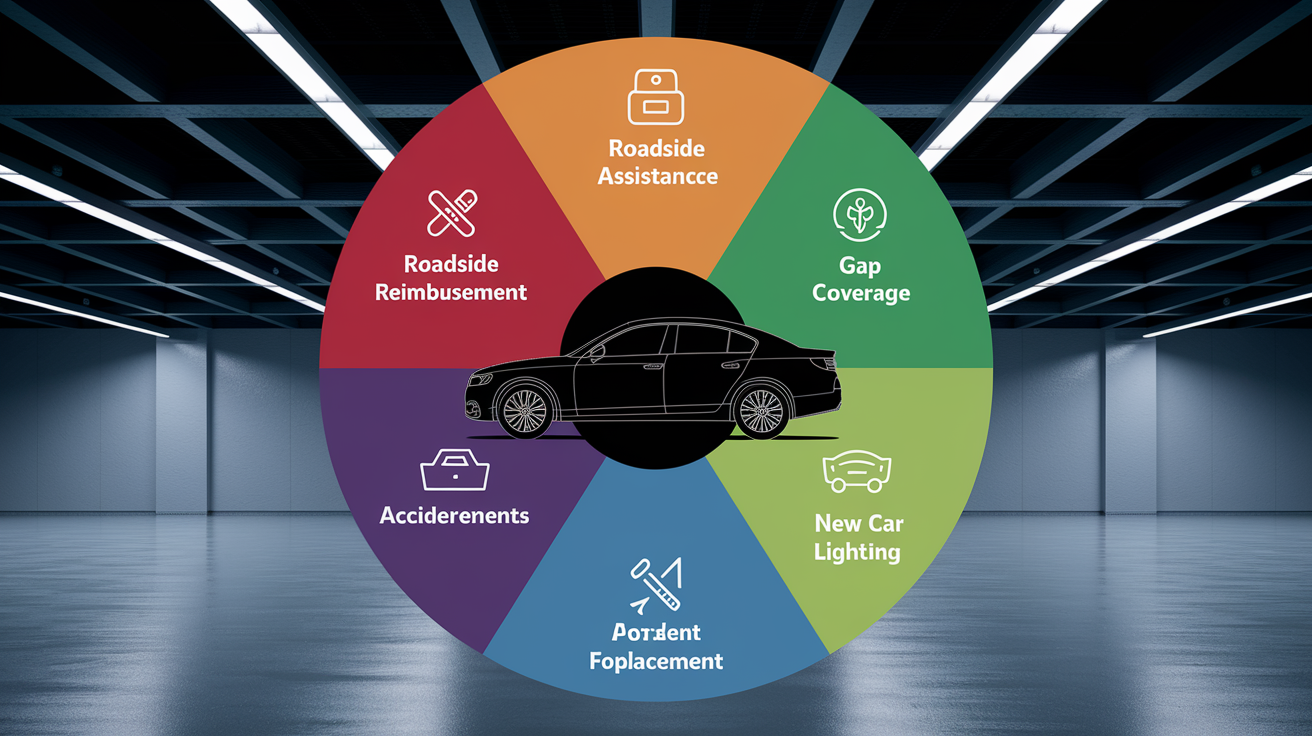
Roadside assistance typically covers towing, battery jump-starts, flat tire changes (using your spare), lockout service, and fuel delivery if you run out of gas. The coverage usually pays up to a set dollar amount per service call, commonly $50 to $150 per tow, and may include a mileage limit, like towing to the nearest qualified repair shop within 15 miles. Some policies cap the number of service calls per year (often three to six), while others are unlimited. Exclusions often include tire replacement costs (the service covers labor to change the tire, not the cost of a new tire), towing for routine maintenance or elective moves, and service outside your policy territory (usually the U.S. and Canada). If you already have roadside assistance through AAA, your credit card, or your car manufacturer’s warranty, check whether your insurer’s version offers anything extra, like higher per-tow limits or coverage for motorcycles and RVs, before paying for duplicate protection.
Rental reimbursement pays a fixed daily amount, typically $20 to $50 per day, for a rental car while your vehicle is being repaired after a covered collision or comprehensive claim. Policies usually cap the total number of days, often 30, which means the maximum payout might be $600 to $1,500 depending on the daily rate and day limit. Some insurers include a waiting period. Your rental coverage doesn’t start until 24 or 48 hours after the claim is filed. Others exclude rentals needed because of mechanical breakdowns, routine maintenance, or theft claims where the vehicle hasn’t been declared a total loss. If your car is in the shop for a week after a collision and you rent a mid-size sedan for $50 per day, you’ll spend $350. If your rental reimbursement limit is $30 per day, the insurer pays $210 and you pay the remaining $140 out-of-pocket. Always confirm the daily limit and whether the coverage applies to all claim types or only certain perils.
Gap coverage (Guaranteed Asset Protection) pays the difference between your car’s actual cash value at the time of a total loss and the remaining balance on your auto loan or lease. If you finance $28,000 to buy a car and two years later it’s totaled in an accident, your insurer might determine the car’s actual cash value is $18,000. You still owe $22,000 on the loan, leaving a $4,000 gap. Without gap coverage, you’d owe that $4,000 to the lender even though you no longer have the car. With gap coverage, the insurer pays the $4,000 difference. Gap insurance is especially valuable in the first two to three years of a loan when depreciation is steepest and you’re likely to be “upside down” (owing more than the car is worth). Some lenders and dealers sell gap coverage as a one-time charge rolled into your loan. Insurers typically offer it as an annual add-on for $20 to $200 per year. Compare both options. Buying gap from your insurer is often cheaper over the life of the loan and easier to cancel if you pay down the loan early or trade in the car.
Accident forgiveness prevents your premium from increasing after your first at-fault accident. Without it, a single at-fault claim can raise your rate by 20 to 50 percent or more at renewal. With accident forgiveness, the insurer agrees not to surcharge you for that first claim. Some insurers offer accident forgiveness as an earned benefit. Drive claim-free for three to five years and you automatically get it at no extra cost. Others sell it as an optional endorsement for $25 to $300 per year, depending on your driving record and the insurer’s underwriting rules. A few carriers include it free for all customers as a retention tool. Check whether accident forgiveness is one-time or continuous (does it reset after you use it, or do you lose it permanently once you file a claim?) and whether it’s transferable if you switch insurers. If you’ve had a clean record for years and your insurer offers free accident forgiveness after five years, it’s worth the wait. If you’ve had a recent claim or you’re a newer driver, paying for it upfront might make sense if the cost is less than the premium increase you’d face after an accident.
New car replacement coverage pays to replace your totaled car with a brand-new vehicle of the same make and model, rather than paying you the depreciated actual cash value. If you buy a $35,000 car and total it six months later, standard collision coverage might pay $30,000 (the depreciated value). New car replacement would pay the $35,000 needed to buy the same new car today. This endorsement typically applies only to vehicles less than one to three years old and under a certain mileage threshold (often 15,000 to 36,000 miles). It costs roughly $50 to $300 per year depending on the vehicle’s value and the insurer’s eligibility rules. The benefit decreases quickly as the car ages. If your car is already two years old, you might only have 12 months left of eligibility, making the annual cost harder to justify. Check whether the coverage pays the original MSRP or the current-year MSRP (prices can increase year over year) and whether it includes sales tax, title, and registration fees.
Key points to verify for each common add-on:
Roadside assistance. Per-tow dollar cap, annual service-call limit, included services (towing, lockout, fuel, tire change), exclusions (routine moves, tire purchase costs).
Rental reimbursement. Daily rate limit, maximum number of days, waiting period, covered claim types (collision, comprehensive, theft, mechanical breakdown).
Gap coverage. What it pays (loan balance minus ACV, or loan balance plus incentives and down payment), eligibility (new purchase, lease, refinance), cancellation terms if you pay off the loan early.
Accident forgiveness. Earned vs. purchased, one-time or renewable, transferability, whether it applies to all drivers on the policy or only the named insured.
New car replacement. Vehicle age and mileage limits, whether it pays original MSRP or current-year MSRP, whether taxes and fees are included, how depreciation is calculated for vehicles at the edge of eligibility.
Red Flags When Evaluating Add-Ons

Strict exclusions and waiting periods can render an add-on nearly useless for your situation. If rental reimbursement excludes coverage for mechanical breakdowns and your car is eight years old with 120,000 miles, there’s a decent chance you’ll need a rental because of a mechanical failure, not a collision. You’d pay for the add-on but never be able to use it when you actually need help. If gap coverage excludes negative equity rolled over from a previous trade-in, and you financed $3,000 of old loan balance into your new car purchase, the gap insurer might refuse to cover that portion, leaving you with unexpected out-of-pocket costs after a total loss. Always read the exclusions section and ask the insurer or agent for real-world examples of when the coverage would not apply. If the exclusions list is longer than the coverages list, or if common scenarios you’re worried about are specifically excluded, the add-on probably isn’t worth buying.
Per-occurrence caps and aggregate annual limits can leave you underinsured even when you think you have coverage. A roadside assistance policy with a $50-per-tow cap might sound fine until you need a tow from a rural highway and the actual tow bill is $180. You’ll pay $130 out-of-pocket. If the same policy caps you at three tows per year and you have four breakdowns, the fourth tow is entirely on you. Rental reimbursement with a $25-per-day limit might not cover even a basic economy rental in some cities where daily rates start at $40. When you’re comparing add-ons, always check whether the limits are realistic for your area and driving patterns. Look up typical tow costs in your region (call a local tow company and ask for an estimate for a 20-mile tow) and typical rental car rates (check an online rental site for your city). If the add-on’s limits fall significantly below real-world costs, you’ll end up paying the difference every time you file a claim, which defeats the purpose of buying the coverage in the first place.
Duplicate coverage with credit card benefits or manufacturer warranties is one of the most common ways people waste money on insurance add-ons. Many credit cards offer rental car coverage if you decline the rental agency’s insurance and pay for the rental with that card. If you already have this, paying your auto insurer for rental reimbursement might be redundant (though note that credit card coverage usually applies only to rentals, not to a replacement vehicle after your own car is damaged). Some credit cards also include roadside assistance as a cardholder perk. New cars often come with three to five years of manufacturer roadside assistance. If you’re still within that window, paying for a separate roadside add-on duplicates protection you already have. Before you add any coverage, make a list of protections you already have from other sources: credit cards, auto club memberships, extended warranties, employer benefits. Cross out any add-ons that overlap. If you’re not sure, call the benefit provider and ask specifically whether the coverage applies in the same situations your insurance add-on would, and whether there are any exclusions or limits that make the insurance version more comprehensive. Only pay for the insurance add-on if it genuinely fills a gap or offers better terms than what you already have.
Tools and Templates for Comparing Add-Ons

A simple comparison worksheet eliminates confusion and reveals hidden costs by forcing you to list the same information for every insurer in a standard format. Start with a spreadsheet or a blank sheet of paper divided into columns. Label one column “Coverage Type,” then create one column per insurer you’re comparing. In each row, write down the name of an add-on or endorsement (roadside assistance, rental reimbursement, gap, accident forgiveness, glass coverage) and fill in the annual cost, limits, exclusions, and any special terms for each insurer. When you’re done, you’ll have a grid that lets you scan left to right and immediately see which insurer charges less, which offers higher limits, and which has better terms. This side-by-side view makes it obvious when one insurer is charging $120 per year for rental reimbursement with a $30/day limit while another charges $90 for a $40/day limit. Without the worksheet, those differences are easy to miss when you’re flipping between separate quote documents.
Use the worksheet to calculate total cost of ownership for each add-on over the policy period. If you’re comparing six-month policies, multiply monthly add-on costs by six. For annual policies, use the annual figure. Then add the cost of all the add-ons you actually want to the base premium to get an apples-to-apples total. This prevents the trap of choosing the insurer with the lowest base premium but the highest add-on costs, which can result in a higher total bill even though the quote looked cheaper at first glance. Also use the worksheet to track non-price factors like customer service hours, claims app ratings, and AM Best financial strength ratings. These softer factors matter when you’re deciding between two insurers with nearly identical pricing. If one has 24/7 claims support and an app rated 4.5 stars while the other only offers phone support during business hours and an app rated 2 stars, the first insurer delivers better overall value even if its add-ons cost $20 more per year.
Four steps for building and using a comparison worksheet:
List every available add-on and endorsement from all insurers. Include items you’re not sure you need yet. You can eliminate them later, but you want a complete picture first.
Record the annual cost, per-incident limit, aggregate cap, deductible, exclusions, and waiting period for each coverage at each insurer. Leave cells blank if an insurer doesn’t offer that coverage or if the information isn’t provided.
Highlight or mark differences that are significant to your situation. If two insurers both offer roadside assistance but one caps tows at $75 and the other at $150, and you live in a rural area where tows often exceed $100, mark the higher limit as a meaningful difference.
Calculate total annual cost for your preferred coverage bundle at each insurer and rank them. Use this ranking to shortlist two or three top candidates, then call those insurers with follow-up questions about exclusions and terms before you decide.
Real-World Examples of Add-On Comparisons

A driver with a three-year-old financed sedan commuting 40 miles per day typically benefits most from gap coverage, rental reimbursement, and roadside assistance. If the car’s current value is $18,000 and the loan balance is $21,000, a total-loss accident would leave a $3,000 gap. Gap coverage costing $100 per year protects against that $3,000 exposure. Clear positive value. Rental reimbursement at $120 per year provides $40 per day for up to 30 days. Since the commute depends on the car, losing transportation for even a week during repairs could mean ride-share bills exceeding $200, so the add-on pays for itself if used once. Roadside assistance at $60 per year covers towing and lockout service. With higher mileage, the risk of a breakdown or flat tire is higher, and a single tow can cost $100 to $150, making the add-on a reasonable hedge. This driver should skip accident forgiveness if the cost is high and the driving record is clean. There’s no immediate benefit, and the $80 to $150 annual cost could instead go toward higher liability limits or a lower deductible.
A driver with a 12-year-old paid-off car worth $2,500, driving 6,000 miles per year mostly for errands, has a different cost-benefit profile. Gap coverage is pointless because there’s no loan. Rental reimbursement is low-priority if the driver has a second household vehicle or can use public transit or ride-share for the few days a repair might take. Skipping it saves $90 to $120 per year. Roadside assistance still makes sense if the car is aging and prone to battery or starter problems. $40 to $60 per year is a small price to avoid a $120 tow bill. Accident forgiveness is worth evaluating if it’s offered as an earned benefit after a certain number of claim-free years, but not worth paying extra for, since the car’s low value means total loss is more likely than repair, and insurance may not be renewed after a total-loss claim anyway. This driver should focus on keeping liability limits high (to protect personal assets) and consider dropping collision coverage entirely if the premium exceeds 10 percent of the car’s value.
A new driver under 25 with a leased vehicle faces higher base premiums and should be selective about add-ons to control total cost. Gap coverage is often required by the lease agreement, so it’s non-negotiable, but confirm whether the lessor provides it or you need to buy it from the insurer. Accident forgiveness is expensive for new drivers (often $150 to $300 per year or unavailable for purchase), so skip it unless it’s earned after a set period. Rental reimbursement is useful because a leased car in the shop still requires a replacement vehicle to meet daily obligations, and the lease contract may require you to maintain transportation throughout the lease term. Roadside assistance is valuable for a young driver who may be less experienced with vehicle maintenance or breakdowns. Focus on building a clean driving record to earn discounts and lower base premiums over time, then re-evaluate add-ons at each renewal.
A driver with two household vehicles, no loan, and a 10-minute commute can safely skip most add-ons. Rental reimbursement is unnecessary because the second car provides backup transportation. Roadside assistance is optional if both vehicles are reliable and under warranty, though it might be worth keeping for peace of mind at a low cost ($40 per year or less). Gap coverage and new car replacement are irrelevant without a loan or lease and with older vehicles. This driver might consider custom parts coverage if one vehicle has aftermarket modifications, or pet injury coverage if pets frequently travel in the car, but otherwise should minimize optional coverages and redirect premium savings toward higher liability limits (to protect home equity and retirement savings) or a larger emergency fund.
| Driver Profile | Recommended Add-Ons | Reason |
|---|---|---|
| Financed car, long commute, clean record | Gap coverage, rental reimbursement, roadside assistance | Gap protects against upside-down loan; rental maintains commute; roadside hedges breakdown risk on high mileage |
| Paid-off older car, short commute, second vehicle at home | Roadside assistance only | No loan means no gap need; second vehicle reduces rental need; low mileage lowers breakdown risk but roadside is cheap insurance |
| Leased car, new driver under 25 | Gap (if not included by lessor), rental reimbursement, roadside assistance | Lease often requires gap; rental maintains transportation per lease terms; roadside covers inexperience with breakdowns |
| Two household vehicles, no loan, short commute | Optional: low-cost roadside only | Backup vehicle eliminates rental need; no loan eliminates gap need; low mileage and reliable cars reduce roadside value |
Final Words
Dive in: scan each quote for exact add-on names, limits, deductibles, and exclusions. Watch price and eligibility — same name rarely means the same coverage.
This post laid out clear definitions, a cost–benefit check, practical comparison methods, common red flags, and a simple worksheet to use. Use the lists and tables as a quick guide.
Start a side-by-side checklist now. Follow the rule “same limits, same deductible, same drivers, same features” when you learn how to compare add-ons and endorsements on car insurance quotes, and you’ll feel confident choosing.
FAQ
Q: What is the best way to compare car insurance quotes?
A: The best way to compare car insurance quotes is to use an apples-to-apples check: same limits, deductible, drivers, address, and mileage, then compare price, add-ons, exclusions, and company ratings.
Q: Are add-ons worth it for car insurance?
A: Whether add-ons are worth it for car insurance depends on your needs; pick ones that match your risk—like roadside for commuters or gap for financed cars—and run a simple cost versus benefit check.
Q: What not to tell your insurance company?
A: You should avoid telling your insurance company anything that admits blame or guesses about fault; stick to the facts, don’t exaggerate damage or injuries, and don’t volunteer extra risk details you can verify later.
Q: What do endorsements mean on car insurance?
A: Endorsements on car insurance mean written changes that modify your policy; they can add coverage, change limits, or remove exclusions and become part of your legal contract with the insurer.