


Want to shave hundreds off your car insurance bill?
Raising your deductible can cut your premium—sometimes by up to 28%—but it also raises what you must pay after a crash.
This post breaks down exactly how deductible choices change your premium and your out-of-pocket claim costs, with clear examples, break-even math, and the common gotchas people miss, so you can pick a deductible that fits your cash flow and driving risk.
How Deductibles Influence Premiums and Claim Costs

A deductible is what you pay out of pocket when you file a covered claim before your insurer kicks in the rest. Most drivers pick something between $250 and $2,500 when they buy or renew. Let’s say repairs cost $3,000. With a $500 deductible, you pay $500 and the insurer covers $2,500. Bump that deductible to $1,000 and you’re paying $1,000 while they cover $2,000. Each separate accident triggers a fresh deductible, so if you’re unlucky enough to have two claims in six months, you’re paying that deductible twice.
Higher deductibles shrink your premium because you’re shouldering more of the initial loss yourself. The insurer faces less exposure on small and medium claims, so they charge less up front. Lower deductibles do the opposite. The insurer starts paying sooner, which means higher average payouts, which means you pay more each month or year. It’s a simple trade: deductible up, premium down.
Collision and comprehensive coverage carry deductibles. Liability and MedPay usually don’t. So when you rear-end someone and their car needs bodywork, your liability coverage pays them directly without asking you for a deductible. When your own car gets crunched in a covered event, that’s when your collision or comp deductible comes into play.
Deductible amount controls premium cost. Raising it by $500 can drop your six-month or annual bill, sometimes by hundreds of dollars.
Out-of-pocket rises with deductible level. A $1,500 deductible saves money now but means $1,500 cash needed after an accident.
Claim payout math is straightforward: repair cost minus deductible equals what the insurer pays.
You pick separate deductibles for collision and comprehensive. You can go $500 on collision and $1,000 on comp if that fits your risks better.
Liability, MedPay, and uninsured motorist bodily injury generally carry no deductible. Those coverages protect others or your medical bills without a per-claim dollar hurdle.
Understanding Deductible Types and How They Apply to Claims

Collision coverage handles damage when you hit another car or object, or when someone hits you and you file through your own policy. Comprehensive steps in for non-crash events like theft, vandalism, fire, hail, flooding, or a tree branch smashing your windshield. Both require your chosen deductible before the insurer pays anything, and you can set those numbers independently. Maybe you pick $500 for collision and $1,000 for comp if you rarely crash but live somewhere hail happens.
Personal injury protection covers medical bills and lost wages after an accident, no matter who’s at fault. Some states require it. When PIP carries a deductible, you’re typically looking at $100 to $2,500. Utah doesn’t allow PIP deductibles at all. Uninsured motorist property damage covers your car when an uninsured driver damages it. That deductible usually runs $100 to $1,000. Mechanical breakdown insurance, if you add it, often comes with a $100 to $1,000 deductible per repair. Liability and MedPay don’t have deductibles because they pay others or cover small medical bills without a threshold you need to hit.
| Coverage Type | Deductible Applies? | Typical Range |
|---|---|---|
| Collision | Yes | $100 – $2,000 |
| Comprehensive | Yes | $100 – $2,000 |
| Personal Injury Protection (PIP) | Yes (except Utah) | $100 – $2,500 |
| Uninsured Motorist Property Damage | Yes | $100 – $1,000 |
| Liability | No | N/A |
| Medical Payments (MedPay) | No | N/A |
Premium Differences at Various Deductible Levels

Raising your collision deductible from $500 to $1,000 can cut your premium by up to 28 percent, depending on your insurer, zip code, and driving history. Moving from $1,000 to $2,000 might save around 17 percent. Those percentages translate differently for every driver. One person might see $150 in annual savings. Another might pocket $400. The only way to know what you’d actually save is to request quotes at two or three deductible levels and compare the numbers side by side.
Premium savings add up over claim-free years, but one accident can erase multiple years of savings if your deductible is high. You can figure out your break-even point by dividing the difference in deductible amounts by your annual premium savings. Say you raise your deductible by $500 and save $150 per year. You break even after about 3.3 years without a claim. File before that point and you pay the extra $500 deductible while losing the premium savings. Go longer than 3.3 years claim-free and you come out ahead.
To run the break-even math yourself:
- Subtract the two deductibles to find the difference in out-of-pocket exposure. Comparing $500 and $1,000? That’s $500.
- Subtract the two annual premiums to find your yearly savings. If the $500-deductible policy costs $1,200 per year and the $1,000-deductible policy costs $1,050, you save $150 annually.
- Divide deductible difference by annual savings: $500 ÷ $150 equals roughly 3.3 years.
- Compare the break-even period to your claim history. If you file more often than once every three or four years, the lower deductible may actually cost less over time. File rarely and the higher deductible saves you money.
High vs. Low Deductibles: Pros, Cons, and Claim Behavior

A higher deductible drops your premium and discourages small claims, because you’re more likely to pay for minor repairs yourself when the cost is close to or below your deductible. Drivers who pick $1,500 or $2,000 deductibles often skip filing for small dents or scratched bumpers, which keeps their claim count low and can prevent premium hikes tied to claim frequency. But you need enough cash on hand to cover that deductible right after an accident. Can’t pay $1,500 out of pocket? The repair shop won’t release your car until you settle the bill or work out a payment plan.
A lower deductible raises your premium but gives you smaller, more predictable out-of-pocket costs when you do file. Paying $250 or $500 after an accident is easier to manage than scrambling for $1,500. Lower deductibles make sense if you drive constantly in heavy traffic, park on crowded streets, or live somewhere with high theft or hail risk, because your odds of filing a claim are higher. The trade is paying more every month or year, and over time those extra premium dollars can add up to more than the deductible difference if you stay claim-free.
High deductible pro: Lower monthly or annual premium, often by hundreds of dollars per year.
High deductible pro: Discourages filing small claims, which protects your claim history and future rates.
High deductible con: Requires immediate cash after an accident, which can be a hardship if savings are tight.
High deductible con: One claim can cost more out of pocket than several years of premium savings.
Low deductible pro: Smaller immediate expense when you file, easier to budget around.
Low deductible pro: Better fit if you expect to file claims or have tight cash flow.
Low deductible con: Higher premiums year after year, which adds up if you never file.
Low deductible con: You may pay more in total premiums over five or ten years than you would’ve paid in deductibles plus higher-deductible premiums.
Claim Scenarios Showing Deductible Outcomes

When you see exactly how deductibles work in real claims, the trade-offs get clearer. Suppose you back into a pole and cause $4,000 in damage to your rear bumper and hatch. With a $1,000 collision deductible, you pay $1,000 and your insurer pays $3,000. With a $500 deductible, you pay $500 and the insurer pays $3,500. That $500 difference in what you pay is the immediate consequence of your deductible choice, and it happens every time you file.
If your car’s totaled and the insurer determines its actual cash value is $12,000, they subtract your deductible and pay you $11,000 if your deductible is $1,000. If the car’s only worth $2,000 and your deductible is $1,500, the insurer may pay as little as $500, because they never pay more than the car’s worth minus the deductible. Sometimes a deductible higher than the vehicle’s value means you get nothing, which is why keeping your deductible below your car’s current market value is basic practice.
Subrogation can change the final outcome. If you file a collision claim and pay your deductible, then your insurer later recovers money from the at-fault driver’s liability insurer, your insurer may reimburse part or all of your deductible. That process takes weeks or months, so you still need the cash up front. The table below shows three claim amounts and what you pay under two common deductible levels.
| Claim Amount | $500 Deductible (You Pay / Insurer Pays) | $1,000 Deductible (You Pay / Insurer Pays) |
|---|---|---|
| $2,500 | $500 / $2,000 | $1,000 / $1,500 |
| $4,000 | $500 / $3,500 | $1,000 / $3,000 |
| $7,500 | $500 / $7,000 | $1,000 / $6,500 |
Factors to Consider When Choosing a Deductible
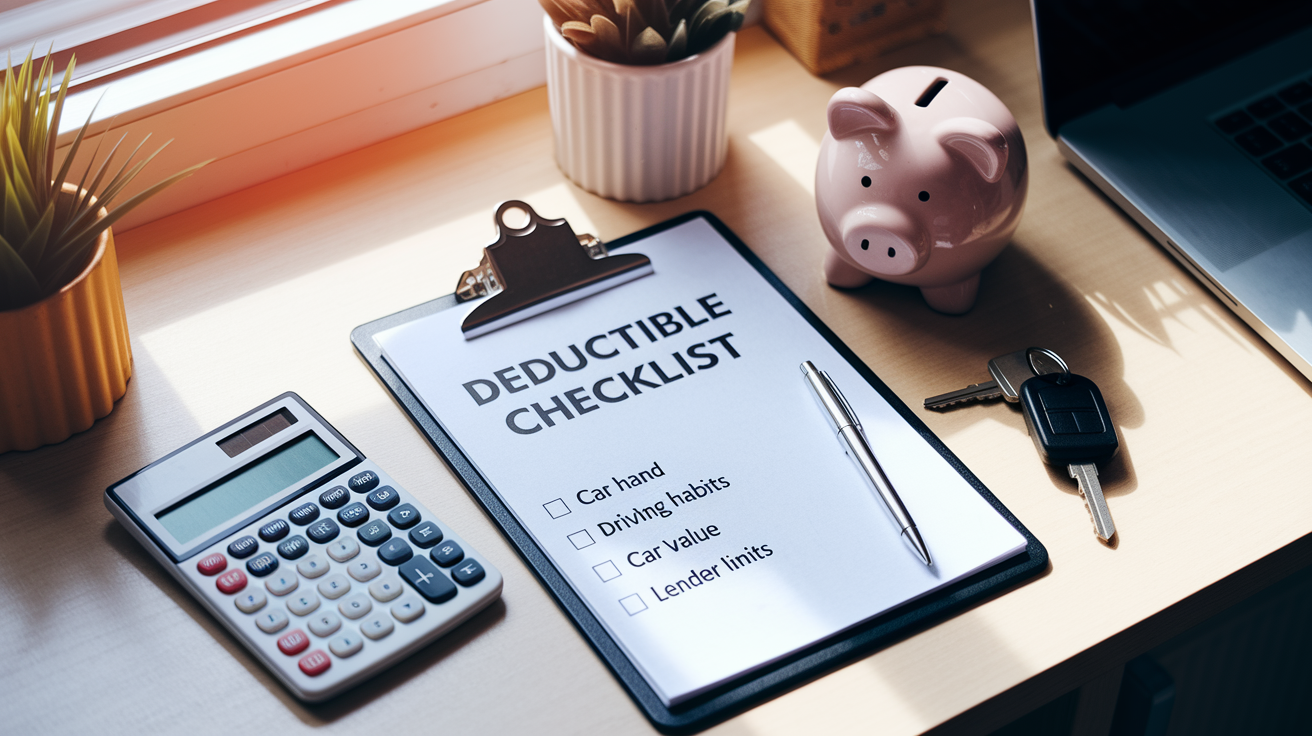
The most important question is how much cash you can comfortably pay right after an accident. If your emergency savings can cover $1,000 without stress, a $1,000 deductible is realistic. If paying $500 would strain your budget, stick with a $250 or $500 deductible even if it means a higher premium. A deductible you can’t afford turns a covered claim into a financial emergency, which defeats the whole point of insurance.
Your driving habits and environment matter, too. City drivers navigating congested streets daily face higher accident odds than someone who works from home and drives 5,000 miles a year. Parking on the street in a neighborhood with frequent break-ins or living in a hail belt raises your comprehensive claim risk. Higher risk usually justifies a lower deductible because you’re more likely to need it. Lenders and lease companies often cap how high your deductible can go, sometimes at $500 or $1,000 for collision and comprehensive, so check those requirements before you choose. Make sure your deductible is less than your car’s actual cash value. If your car’s worth $3,000 and you pick a $2,000 deductible, a total loss claim pays you only $1,000, which may not be enough to replace the vehicle.
- Check your savings and monthly budget. Pick a deductible amount you could pay tomorrow if you had to, without borrowing or skipping other bills.
- Estimate your claim likelihood. Count how often you’ve filed in the past five years, and think about whether your driving exposure or location risks have changed.
- Verify lender or lease deductible limits. Call your lender or review your lease paperwork to confirm the maximum deductible allowed on collision and comprehensive.
- Get quotes at multiple deductible levels. Request premium figures for $250, $500, and $1,000 (or any three levels that interest you) and compare the annual cost differences.
- Confirm your car’s current value. Look up your vehicle’s actual cash value using a pricing guide, and make sure your deductible is lower than that number.
- Add up all your deductibles. If you carry PIP, collision, and comprehensive, you could face multiple deductibles in one serious accident. Make sure you can afford the combined total.
Situations Where You May Not Pay a Deductible

When another driver causes the accident and their liability insurance accepts responsibility, you usually file a third-party claim directly with their insurer and pay no deductible. The at-fault driver’s liability coverage pays for your repairs or replacement without requiring you to use your own collision coverage. If you file through your own collision coverage first to speed up repairs, you pay your deductible, but your insurer may recover it later through subrogation and send you a reimbursement check once they collect from the other party.
Some insurers waive the comprehensive deductible for glass repairs, especially windshield repair as opposed to full replacement. A few states mandate zero-deductible glass coverage. Vanishing-deductible programs reward claim-free years by reducing your deductible by a set amount annually, sometimes down to zero after five or six years without a claim. Liability claims never require you to pay your own deductible because that coverage pays for damage you cause to others, not your own vehicle.
Another driver is at fault and their insurer accepts the claim: you typically pay nothing out of pocket.
Comprehensive glass repair waiver: some policies cover windshield repairs with no deductible.
Vanishing deductible feature: annual claim-free credits can reduce or eliminate your deductible over time.
Subrogation recovery: if your insurer recovers your deductible from the at-fault party, you may receive a refund weeks or months after the initial claim.
Practical Tips to Lower Premiums Without Choosing the Wrong Deductible

Discounts can trim your premium by 10 to 25 percent or more without forcing you into a deductible you can’t afford. Bundling auto and home or renters policies with one insurer often unlocks multipolicy discounts. Setting up autopay or paying your premium in full up front may earn you a payment discount. Safe-driver, good-student, and defensive-driving course discounts reward low-risk behavior and can stack. These discounts lower the base premium, so even if you keep a $500 deductible, you still pay less overall.
Credit-based insurance scores affect premium levels in most states. Improving your credit score by paying bills on time, reducing debt, and disputing errors can lower your rate at renewal. Usage-based insurance programs track your actual driving through a smartphone app or plug-in device and adjust your premium based on miles driven, hard braking, and time of day. Safe drivers in these programs can justify lower deductibles because their real-world risk is documented and rewarded with cheaper premiums. When you shop for quotes, always compare the same coverage limits and deductibles across multiple insurers, because base rates vary widely and one company’s $1,000-deductible policy may cost less than another’s $500-deductible policy.
Bundle home, renters, or other policies with your auto insurer to earn multipolicy discounts, often 10 to 20 percent.
Enroll in autopay or pay the full term up front to claim payment discounts that reduce your bill without touching your deductible.
Ask about safe-driver, good-student, and defensive-driving discounts that reward low-risk behavior and stack with other savings.
Check and improve your credit-based insurance score by paying bills on time, lowering debt balances, and correcting credit report errors.
Consider usage-based insurance programs that track your driving and lower premiums if you drive safely, which can offset the need for a very high deductible.
Final Words
You saw what a deductible is, how higher deductibles often mean lower premiums, and how they change what you pay after a crash or other damage.
Now take one small step: compare quotes with the same limits and run the simple break-even math for your budget. This will show how deductible affects car insurance premium and claims and help you choose a level you can afford if something happens. Do that, and you’ll keep solid protection without surprises.
FAQ
Q: How do $500, $1,000, $1,500 and $2,000 deductibles compare and which is better?
A: Choosing between $500, $1,000, $1,500 and $2,000 deductibles depends on how much you can pay after a loss. Higher deductibles lower premiums but raise your out‑of‑pocket; pick what you could afford today.
Q: Will my premium go up if I lower my deductible?
A: Lowering your deductible will often raise your premium. Expect a noticeable increase, sometimes about 20 to 30 percent when moving from $1,000 to $500, so get quotes before you switch.