


Think reporting a fender-bender will blow up your rates overnight?
Not quite. Insurers usually change your price at renewal, so the real cost can show up months later.
A single at-fault crash can raise your premium 20% to 40%, turning a $1,200 policy into roughly $1,440 to $1,680 a year.
Read on to see which claims hit your bill hardest, how long surcharges stick around, and a simple if-then test to decide whether to file or pay out of pocket.
How Filing a Claim Impacts Your Insurance Costs Immediately

Filing a claim won’t spike your premium the second you call your insurer. The increase shows up at renewal, which could be next week or six months out depending on where you are in your policy term. Insurers recalculate your rate when it’s time to renew, not the day you report the accident. How much your rate goes up depends on what kind of claim you filed, your driving history, and the company’s rating rules.
For a single at-fault collision, most drivers see increases between 20% and 40%. If you’re paying $1,200 a year, that’s a jump to somewhere around $1,440 or $1,680 annually. Bigger accidents or stacking multiple claims in a short window can push increases past 50%. Not-at-fault and comprehensive claims usually produce smaller bumps, often between 0% and 15%, since insurers don’t see those as strong predictors of future risk.
Surcharges stick around for years, so your premium stays elevated even if you drive perfectly during that time. The dollars add up fast. A 30% increase on a $1,200 policy means an extra $360 per year. Over three years, you’ve paid $1,080 just for that one claim.
Here’s what typical surcharge ranges look like:
- Minor at-fault collision: +20% to +30%
- Major at-fault collision: +35% to +60%
- Comprehensive claim: 0% to +15%, sometimes no surcharge
- Not-at-fault collision: 0% to +10%, often no change if fault is documented
- Multiple claims within three years: +50% or more, or you might face non-renewal
How Long a Claim Affects Your Premium

Most insurers keep accident surcharges on your rate for three to five years after the claim date. The exact timeline depends on state rules, your insurer’s underwriting guidelines, and how serious the accident was. A standard at-fault collision typically affects your rate for about three years. Major violations like DUI can stick around for five to ten years.
State regulations vary a lot. Some cap surcharge periods at three years. Others let insurers look back further. Even after the surcharge drops off, the claim stays on your CLUE report for seven years. New insurers can still see it when you shop around, and it might influence their decision to offer you coverage or what rate they quote.
Older claims matter less over time. An accident from four years ago carries way less weight than one from last month. Keep your record clean for three to five years after a claim, and your premium will gradually move back toward what you were paying before.
Key Factors That Determine Rate Increases
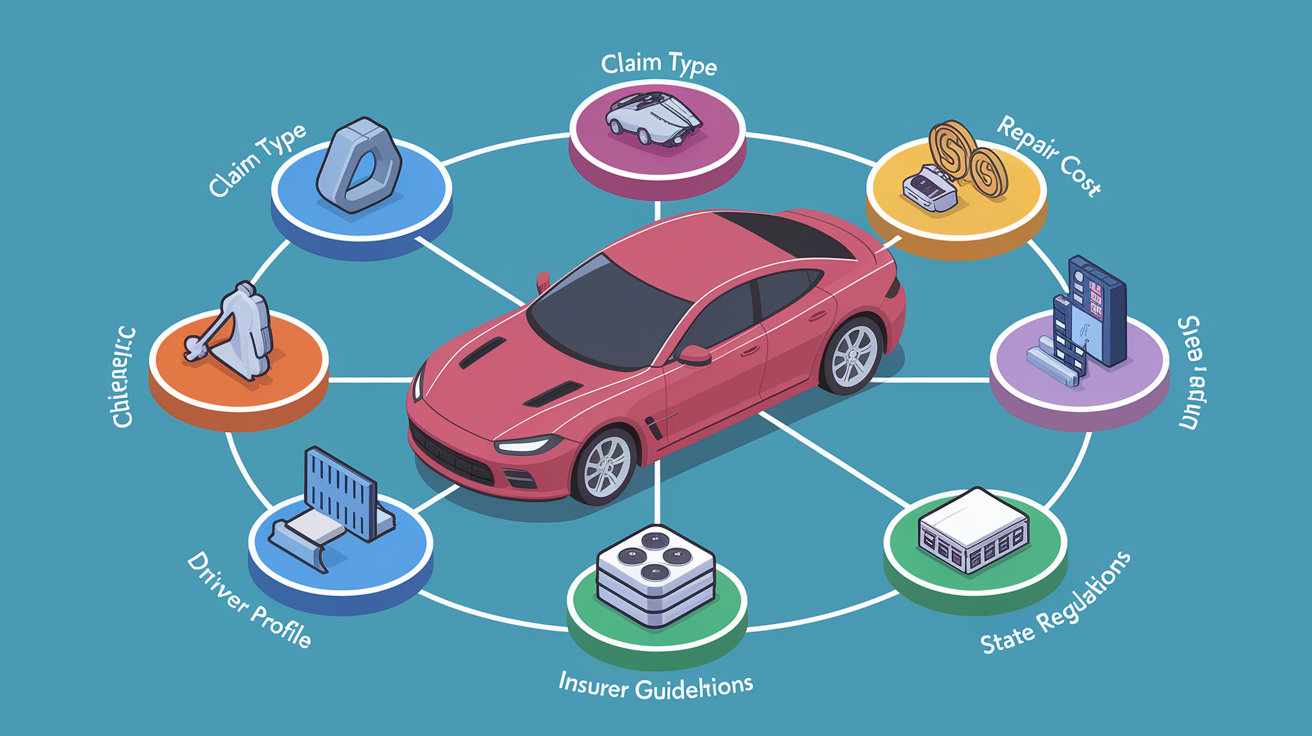
Insurers don’t use a universal formula. They weigh multiple data points when they recalculate your premium after a claim. Two drivers with identical accidents can see completely different rate changes because their age, location, claim history, or policy features differ.
Claim severity matters. A $500 repair might trigger a 20% surcharge. A $10,000 payout often leads to 40% or higher. But frequency matters just as much. Two small claims in two years can produce a bigger increase than one large claim, because insurers interpret repeated claims as a pattern.
Your driving record before the claim also plays a role. Someone with ten clean years usually faces a smaller increase than a driver who already has speeding tickets or prior accidents on file. Insurers also factor in your location, credit-based insurance score (where it’s legal), vehicle type, and whether you carry optional features like accident forgiveness.
Six things that shape your rate increase:
- Claim type: at-fault collision, not-at-fault collision, comprehensive, glass-only, or liability claim
- Repair cost and payout amount: higher payouts usually mean steeper surcharges
- Frequency of claims: multiple claims in a short period signal higher risk
- Driver profile: age, years licensed, prior violations, and claims history
- Insurer guidelines: every company uses its own rating algorithm and surcharge tables
- State regulations: some states limit surcharge amounts, durations, or prohibit certain rating factors
At-Fault vs. Not-At-Fault Claims

At-fault accidents almost always trigger a premium increase. When you cause a collision, your insurer covers the other driver’s vehicle and medical bills, plus your own car if you carry collision coverage. The insurer sees you as higher risk and adjusts your rate. Typical increases range from 25% to 50% for a single at-fault accident, depending on severity and your history.
Not-at-fault accidents usually have little or no impact on your premium. If the other driver is clearly responsible and their insurer pays everything through subrogation, many insurers won’t raise your rate. You still report the accident to your own insurer, but the claim is coded as not-at-fault, and the payout comes from the other party’s policy. Some states and insurers do apply small surcharges to not-at-fault claims, but increases are typically 0% to 10%, far below at-fault claims.
There are exceptions where not-at-fault claims can still raise your rate:
- Multiple not-at-fault claims within a few years: insurers might view frequent claims as a pattern, even if you weren’t responsible
- Disputed or unclear fault: if liability is contested or the police report is ambiguous, your insurer might treat the claim as partially at-fault
- State and insurer policies: a handful of insurers and states allow surcharges for any paid claim, regardless of fault
When Filing a Claim Makes Financial Sense

Filing a claim only saves you money if the insurer’s payout exceeds the combined cost of higher premiums over the next few years plus your deductible. A quick calculation helps. Multiply your current annual premium by the expected percentage increase, then multiply that result by the number of years the surcharge will apply. Add your deductible. If that total is less than the repair cost, filing makes sense. If it’s more, paying out-of-pocket is usually cheaper.
Deductibles and surcharge duration are the two biggest variables. A $500 deductible means the insurer only pays for damage above that amount. If your repair costs $1,200, the insurer pays $700. If the premium increase over three years totals $1,200, you lose $500 by filing. But a $5,000 repair with a $500 deductible means the insurer pays $4,500. Even if premiums rise $1,500 over three years, filing saves you $3,000.
When filing usually makes sense:
- High repair costs: damage well above your deductible, especially if the claim payout is several thousand dollars
- Injuries or medical bills: any bodily injury claim typically justifies filing because medical costs and liability exposure can escalate quickly
- Third-party liability: if you damaged someone else’s property or injured another person, your insurer provides legal defense and pays claims up to your policy limits
- Total loss: if your vehicle is totaled, the insurer’s payout minus deductible is often far larger than the long-term premium increase
- Multiple vehicles or severe damage: when repair costs span multiple vehicles or exceed your liquid savings, filing protects your finances
When paying out-of-pocket usually makes sense:
- Minor cosmetic damage: small dents, scratches, or paint touch-ups that cost less than twice your deductible
- Repair cost barely above deductible: if the insurer’s net payout is small, the premium increase often costs more over time
- Recent claims on your record: another claim within a few years can trigger disproportionate increases or risk non-renewal
- Low annual premium: if you already pay very little, even a small percentage increase compounds quickly over multiple years
- Ability to negotiate cash repairs: if a repair shop offers a discount for direct payment, you might save more than the insurer would pay
How to Reduce or Avoid Premium Increases After a Claim

Accident forgiveness is the most effective tool if your insurer offers it. This feature waives the surcharge for your first qualifying at-fault accident, as long as you meet eligibility requirements like a clean driving record for a certain number of years. Some insurers include forgiveness automatically after you’ve been claim-free for three to five years. Others sell it as an add-on endorsement. Check whether your policy already includes it or ask your agent to add it before your next renewal.
Switching insurers after a claim can sometimes reduce your rate, even with the accident on your record. Every insurer weighs claims differently. One company might surcharge you 40% after an at-fault collision, while another quotes only a 20% increase. Shopping around takes time, but comparing quotes from three to five insurers often uncovers savings. Make sure to compare identical coverages, limits, and deductibles so you’re measuring apples to apples.
Lowering your risk classification helps, too. Keeping a clean driving record for several years after a claim gradually reduces the surcharge. Taking a defensive driving course can earn you a discount in many states. Bundling your auto policy with homeowners or renters insurance often unlocks multi-policy discounts that offset part of the increase. Some insurers offer telematics programs that monitor your driving habits and reward safe behavior with lower rates.
Steps to minimize premium increases:
- Add or confirm accident forgiveness: ask your insurer if you’re eligible or if you can purchase it as an optional coverage
- Increase your deductible: raising your deductible from $500 to $1,000 lowers your base premium, which reduces the dollar impact of any percentage increase
- Enroll in usage-based insurance: telematics apps track safe driving and can reduce rates by 10% to 30% if you drive carefully
- Maintain continuous coverage: avoiding lapses in insurance keeps you eligible for loyalty discounts and prevents higher rates that come with gaps in coverage
Final Words
You now know the essentials: how much a claim can bump your premium, how long surcharges usually stick around, and which factors insurers use when they recalculate rates. You also saw the difference between at-fault and not-at-fault claims, plus a checklist for when filing makes sense.
Use the steps in this article: run the math, ask about forgiveness or discounts, and think twice about small claims. That way you can keep control of how filing a claim affects car insurance rates and stay protected without paying more than you need.
FAQ
Q: How much will insurance go up after filing a claim?
A: Insurance rates often rise about 20% to 40% after an at-fault claim, with smaller increases for comprehensive-only claims; the exact jump depends on claim severity, your driving record, and the insurer.
Q: What not to say to the insurance adjuster?
A: You should avoid telling the insurance adjuster that you caused the accident, guessing fault, admitting injuries are minor before a medical check, or giving long emotional statements; stick to clear facts and dates.
Q: Is it worth claiming on car insurance? What is the downside of filing an insurance claim?
A: Deciding whether claiming on car insurance is worth it means weighing downsides like higher premiums, multi-year surcharges, and lost discounts. If repair costs are less than likely long-term increases, pay out-of-pocket.